Showing posts with label BSU Archive. Show all posts

Saturday, 25 October 2014

Come and See!

Since moving back to Newton Park in June, we've been delighted to welcome a range of visitors to the Archive office in the Castle.

From current students having a wander around campus, to a local walking group stopping for a chat, it's always good to meet new faces. Current students can tell us about the student experience today, and in every group of women there is the chance that one of them trained here in the past. Such was the case recently, and those women were interested to see the new student accommodation, the 'Gardens', nearing completion. Its fascinating to hear the ways in which the student experience has stayed the same in some ways, yet changed out of all recognition in others. They may have different work patterns, expectations and burdens, yet they still report being awed by the landscape, woken by the cows and finding lifelong friends here.

Last week, we welcomed a large group of visitors into the office. The Holburne Museum Trustees had enjoyed a tree walk around the lake before dropping in to see the exhibition we're currently preparing, and having a strong interest in history, were most interested in finding out more about our beautiful setting and the university's history.

The Holburne Museum Trustees during their recent Archive visit. 

The Holburne is Bath Spa University's partner museum in Bath, and many of our students - from a wide range of courses - volunteer, work and carry out projects there. The university also hold our 'Centre for History & Culture' monthly lecture series there, in which notable historians and speakers deliver their recent research.

The Archive exhibition itself, now ready, will be open during the first week of November, from 10am until 3pm, Monday to Friday. Those already on campus can pop in any time, and visitors can come along to the office, on the ground floor of the Castle. You'll need to pick up a visitors parking permit at the Security Lodge on your way in, or better still, take any of the frequent buses from the centre of Bath. We're a short stroll up from the library bus stop.

BSU Archive exhibition - almost ready to open!


We hope to welcome you soon.

Kate

Wednesday, 29 January 2014

Dances, Dates and Writing Home

As a new member of the Archive team here at Corsham Court, I was excited to see some more of the collection this week. I really enjoyed reading the letters of Vivianne Ollerearnshaw, who studied on the teacher training course at Newton Park from 1951- 53. Her interview and the letters which she kindly gave to the Archive cover her two years at the college, and provide a wonderful glimpse into life as a student at that time.

During her first year Vivianne lived on the top floor of No. 19 of the Royal Crescent, along with 8 other girls. They shared one big bathroom between them and ate in the large basement; 'our first meal was rabbit stew, which was gorgeous, and custard with banana in it which I shall never forget because we were rationed, we never had enough to eat at home.' In her second year Vivianne lived at Newton Park, in Main House. The had 'a huge breakfast, a huge dinner and a huge supper and tea' everyday in the East Wing, which today is a small cafe. I love the little openings into the details of her life as a student; among other things Vivianne writes to her parents about playing hockey and netball matches between Newton Park and The Elms (P.S. We've won the netball match!'), about going to see Wuthering Heights 'with Lawrence Olivier in' and also about holidays; 'For the Coronation we get not far off a week!'.


'Wuthering Heights will be at Bath next weekend, with Lawrence Olivier in. I've seen it once, but would love to see it again if time.' 


Many of her letters are signed with 'xxxx' and use shortenings such as 'if poss'. This is surprisingly similar to texts and informal emails today- my friends and I use them! In one of the letters, Vivianne is asking her parents for references. The language used seems quite abrupt, and as with the similarities to texts mentioned above, this reminded me that letters were the main form of communication (apart from the telephone', so in a way they did the job of what texts and emails do now. On the other hand, one of the main differences is that many were written over several days. The envelopes have very readable postmarks, unlike today, and the range of stamps is interesting.

Her handwriting is very twirly compared to how my generation were taught to write!

Another thing that surprised me is that the term 'going out' was also in use then. In Vivianne's time it often meant going to dances; she writes about the Weston in Bath ('a little dance place') and about a Valentine's Ball at Bristol University, whereas now 'dances' is clubbing! A little later she wrote about refusing to see 'a partner', meaning a male dancing partner, because she 'musn't go out this term'. I think this shows how some phrases have become outdated, while some are still very much in use amongst people my age. And now that 50s style is back in fashion, it makes me think that maybe some things about youth culture never really change!

By Alice Meigh, 2nd year student at Bath Spa University

Tuesday, 29 October 2013

Reunions, Reminiscence and Reflections

During the past few months, the BSU archive team have been fortunate enough to be part of several Alumni Reunion events, organised by Ruth Russell from the Alumni office at the university.

Groups of former students are welcomed back to Newton Park, and enjoy refreshments and a chance to be together once more, in the beautiful surroundings of the main reception rooms of Main House. Later, there's the chance for a walk around the grounds, with a guide from the archive or alumni teams to talk about some of the new developments on campus. 

Sharing stories with the class of 1963-66
The women of 1963-66
The archive team always put on a display of materials, documents and images from the relevant era, and talk to the group about their memories and experiences of life at college in former times. If we're lucky, new donations are made to the collection by the people who come back. Alternatively, those who bring their photographs and documents for us to see can have them scanned on the spot, which was the case at the most recent events last week.

We can also make arrangements for people to come back for oral history interviews at another time, or take down the details of contacts for the future.

Each time one of these meetings occurs, we learn something new; yet another layer of history to add to our ever-growing archive collection. On Saturday we heard for the first time, about the protest and sit-in of 1976, when students occupied main house to demonstrate against the shortage of jobs in the teaching sector. Emulating the photographs taken back then, three former students climbed onto the window ledge outside main house in an echo of that long hot summer of  the mid-70s, when flares were at their most extreme, and seemingly everyone had loads of long hair...

Pictures of the past - images from 1975-76. The student sit-in is featured, top centre

Recreating the student sit-in. (Class of 1973-77)
Its a great privilege to be at these events, and share experiences of the past in a setting we all appreciate. The majority of people we've met so far were trained as teachers, and I feel there is something quite distinctive about them. They have developed in others a love of learning, kindled sparks in children and young people, and made themselves heard, one way or another, in decades of education. They are interesting, thoughtful, intelligent and appreciative of the education they received. Of course these are generalisations, but here in the archive we have had many chances to discuss the people we've met, and these are the conclusions we've come to.

We hope to be able to be an intrinsic part of these reunions for a long time to come, and to be there to hear and share many more stories. 

Lunch, a chat and a DVD of old photographs, with the class of 1973-77

(all new photographs taken by Kate James)


Tuesday, 7 May 2013

Bugs, damp and rusty pins: Conservation challenges in the archive

Here in the archive, although most of our documents are relatively modern (20th century onwards) we still have to consider the potentially damaging effects of the environment.

The 'nine agents of deterioration' is a theme very familiar to Conservator Emma Gatehouse, a Bath Spa graduate who now works for the National Trust. She developed an interest and expertise in this area during MA Heritage Management studies at BSU, and has advised the archivists here on aspects of preservation and collections care. (By the way, those nine agents of deterioration are fire, water, loss, physical, chemical, biological, light, humidity and temperature)

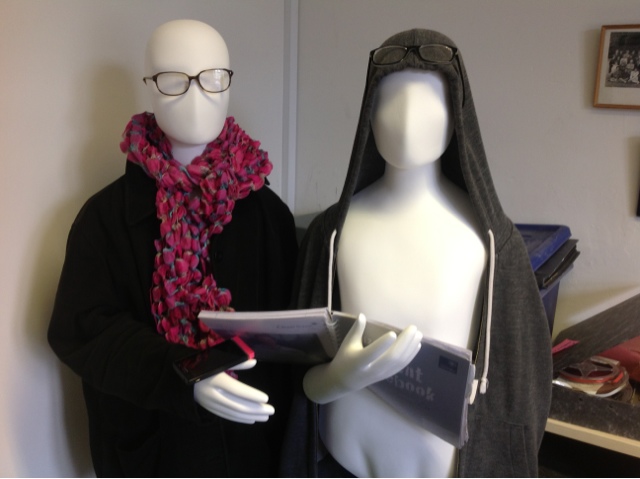
As well as being an archive storage area, our room at Corsham Court is also a working office, so the rather cool temperature has to be accommodated through extra jumpers for the archivists! It also means that we are surrounded by archive quality storage boxes, and in the corner, our two display mannequins stand, awaiting their chance to show off any period clothing. On a day to day basis, 'Archie' and 'Little Archie' model our coats and scarves for us, and move their positions according to who was last in the office (or do they actually move independently...?) If anyone is ever in the office on their own, the mannequins either keep you company or give you the creeps, depending on your frame of mind...
Archie Archive and Little Archie, modelling our coats...

Conservation issues vary with the rest of the archive materials. During office hours, care needs to be taken with food, drink or greasy fingers; we can't risk the documents when it comes to careless handling. Some of the postwar papers, from the early days of Newton Park, are copies of letters and were produced on very fragile paper. There were paper shortages at this time, and so copies were produced on tissue-thin fragments. Many of ours were filed at the time, in bulky bundles, held tightly in one vulnerable corner by a brass split pin, which has long since rusted in position. The papers now need to be removed, but this risks further damage in the process.

Tissue thin paper, in a bundle of letters from May 1945
Other issues surround the manner in which documents were produced at the time, and items such as glue, sticky tape and paper clips can themselves damage any papers to which they are attached.

A photograph of Thelma Willoughby, in the photograph album she kept of her years at Newton Park. The album was passed to the university after her sudden death in a bookshop a few years ago. The album contains a wonderful record of the years 1949-1951.
But what shall we do with that paperclip, rusting away in the corner?
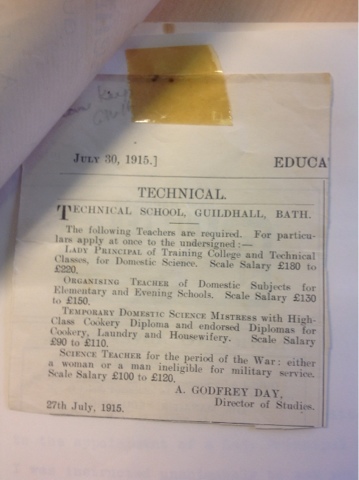
Ancient sticky tape? The cutting is from 1915, but it was taped into this scrapbook much later. Removal will mark and possibly also damage the paper.
Some of the long college photographs are rolled so tightly, they can barely be unrolled. Doing so is an exercise in patience, as previous owners of such photographs have discovered. Some have come to us cracked and damaged, especially at the ends.

Domestic Science College photograph 1937. Like a coiled spring, it won't unroll beyond this !

Collections such as albums and scrapbooks are often best left intact, whatever their condition, since handling or dismantling will not only damage them further, but change the nature of the grouping. Two overstuffed scrapbooks exist of Principal Mary Dawson's early years at Newton Park, compiled by a good friend and supporter. They represent the challenges and triumphs of those early years in a way which is unique, so we will just handle them with care!

Mary Dawson's scrapbook, kept by her friend. A treasure trove of memorabilia from 1946 

Some documents are well beyond our scope and skills, and the 19th century parish maps which once belonged on the Gore Langton estate had to go to the expert conservators at Wiltshire and Swindon History Centre. The repaired maps look great, and one now hangs in the Main House reception at Newton Park, for everyone to enjoy.

Estate Map of Newton Park, beautifully flattened and restored - well, all the pieces that were saved over the years, anyway...

Finally, our Conservation adviser, Emma Gatehouse told us the most important rule to bear in mind when working with any kind of archive document, and one which is used by all collections, however big or small, important or humble. (Especially useful when funds, time or space are short!) 'The Three C's' - namely Caution, Compromise and Common Sense.

And now, time to tackle those rusty split pins....


Monday, 29 April 2013

Mrs Thatcher's Generation

Whatever your politics, you will not have been able to ignore the death of Margaret Thatcher, a woman we all know something about. Whether through direct experience, or through the stories which have been published over the past weeks, we all know something of the life, work and achievements of this country's first woman Prime Minister.

Mrs Thatcher's generation? The Class of 1949 at Newton Park
I can see many parallels between women like Margaret Thatcher and the generations of former staff and students we have interviewed. These interviewees are predominantly women, as in the past we produced mostly women teachers. And because these women trained to be teachers, they had careers, some long, some short.  Some married, some had children. Most continued to work to some degree or another. They are the generations who grew up in the shadow of war, who attained a certain standard of living, promised in the aftermath of the thirties and forties in Britain. This cultural background coloured their opinions, their upbringing and their education, in a way which we struggle to understand today. 
1948: A student attends an interview with Miss Dawson, accompanied by her parents (and younger sister?) . Newton Park was not ready for use until 1949, so may only have been visited for the interview and annual Commemoration Day in June.

It seems to me that people then got on with things in a different way. Instead of fussing about things, you put your head down and worked hard, since, by contrast to wartime conditions, life was a good deal better. The privations of their youth (wartime restrictions and so on) coloured their future lives. My generation ridiculed this tendency; we certainly didn't understand it.

During the oral history interviews, I've been ready to hear about issues of feminism, of equal rights, and of unfair treatment towards working women. Although on one hand it seems a little disappointing when these things are absent, it also makes me feel humble to know that in the 1950s and 1960s, you proved yourself by simply getting out there and getting on with it. The only 'complaint' was around the firm expectation that a woman teacher should wear a skirt!

Sue, at Wellow Station on her way to teaching practice, early 1960s.
(Photo: S.Tewson)
I myself come from a family of similarly strong women, who ran businesses with their families, and tackled any tasks which happened to need doing. I'm not sure if my feisty grandmother would have described herself as a feminist (or whatever the term would have been for her generation) but she certainly expected people to work hard and make a difference to their lives - the difference being dependent on the amount of hard work one was willing to put in. This attitude, born of a particular time and place, is perhaps now passing from our culture (discuss?!)

Famous people like Margaret Thatcher will have their stories told many times. The history books will be filled with details, opinions and analysis of the part they played in the nation's story. Not so the thousands who got on with the job every day, and lived through the same years. 

Oral History is a way to counteract this. By talking to the people who experienced life here, we hope to bring the nuanced details of history to the archival record.

Commemoration Day choir performance, 1964 (Photo: S. Tewson)

We continue to welcome a host of fascinating people to interview. Next month will be the turn of a former Newton Park student from the 1950s and a music lecturer who saw several decades of change in the same setting. Its always a pleasure to hear their words, and we look forward to sharing their stories.


Wednesday, 17 April 2013

Digitisation Doctor Conference

Starting off a series of 'guest' blog entries, the Archive (or at least half of it) had an away day today, and attended a digitisation information event in London. Being from London myself, it's always great to get to go back, particularly for educational/academic visits. I've had the pleasure in the last year of being able to visit the British Library for an Oral History Workshop, for example.

Kate and I went to the Wellcome Trust at Euston, a building which I have passed many times on my travels around town but never had the privilege to visit before. It was a great venue and I must say I loved the modern style of the architecture, a great juxtaposition to the great St Pancras Hotel - or St Pancras Station if you believe the Harry Potter franchise - a few hundred yards away.

The Wellcome Trust was a great venue

I think it's fair to say that we were treated to an outstanding day, my first proper conference of sorts, having attended a number of workshops with my secondary school. The papers were varied but all highly applicable to the developments at the Archive.

I could easily highlight any of the presentations but I want to mention specifically William Kilbride (follow him on Twitter @WilliamKilbride) from the Digital Preservation Coalition. His 'Preservation Planning in 12 Questions' was particularly brilliant and I can definitely see myself incorporating this into my MA in the coming two years. On a personal note I am thrilled to have been accepted on that course and look forward immensely to continuing my studies here at Corsham Court.

These are some great questions that preservation projects would do well to keep in mind... 

I also particularly enjoyed Christy Henshaw (@Chenshaw) who spoke about workflows in digitisation projects. Her flow diagrams certainly took me back to the project modules I did on my ICT A-Level. Memories! Finally, I wish to mention Simon Tanner (@SimonTanner) and his talk on Optical Character Recognition (OCR). It has certainly led me to appreciate the systems available via Bath Spa University's Electronic Services. I cannot help but feel a lecture on this to undergraduates would help them to appreciate the enormity of the scope of putting such resources online, and why currently they cannot hope to be 100% accurate.

All of the talks had some resonance with our project, though, and elements of them all will no doubt feature on our work as it progresses in the next couple of years. It really is an exciting time for anyone associated with the BSU Archive!

There was also time for discussion with the rest of the group, and we were fortunate enough to be able to chat with some representatives of the Collections Trust, based at the Natural History Museum, South Kensington. They opened our eyes to some fantastic funding opportunities available through the European Commission, particularly the Europeana project. This looks like it could have the makings of a fantastic portal for materials across Europe. I highly recommend it to any fellow students or those interested in European history in general. Who knows what one might find there?

The day was made even better with the use of Twitter, allowing members of the group to communicate with the speakers once they had finished. They were also able to post up their slides before they spoke so that we could follow on our connected devices as well as on the projector. For those interested, you can have a look through the tweets using the hashtag #digidoctor. For someone involved with IT, it was an excellent use of social media to help add to an already excellent event. In my opinion it really showcased the power of social media.

Today has certainly got my creative juices going and I can already think of directions to take the digitisation of the project forward, particularly in relation to OCR systems, funding, planning and development of a cataloging and online digitisation system. I have really enjoyed today and once again look forward to helping the project to develop in the future. I could write so much more but I think I leave more detailed specifics (for now!) to my own private reflective blog for the project. Good things come to those who wait...

There was even some time to stop by one of my favourite watering holes in the area before heading back to Paddington for the train to the West Country. As I write we are being delayed by signalling problems, some things really never change! Had a beautiful sunset to bid me a fond farewell from the capital, so it's not all bad news.

From the train coming out of London

I would once again like to point a friendly finger towards our own Twitter presence, @BSUArchive. Please do give us a follow to keep up with our latest news.

Richard

Wednesday, 10 April 2013

Oh...the weather

While we shiver and wait for the spring to arrive, here at the archive office Oral History interviews have continued. We always have to apologise for the coolness of the office itself - but it is an archive after all!

Over the past two years, we have heard from around fifty people, who have either told us, or written down their memories. The majority of these people are former students, and about a quarter were staff members.

Visiting schoolchildren investigate the chicks at Corsham Court. A 1950s  spring scene.
So many people have strong memories associated with the weather, and again and again we have been struck by the way that extremes of weather affect people. Consider our recent experience, and the way that this long, cold winter and late spring has affected those around you. At Bath Spa University, it has certainly played its part, and the third year dissertation students seem to be even more stressed than usual. Normally, by now, they would have been able to shed a few layers of clothes, and perhaps enjoyed that freer feeling that comes alongside spring flowers and birdsong. They are, however, still bundled up, struggling against a bitter wind as they trudge up and down the Newton Park driveway. But the life of the student now is a cold one on the whole; by the time the really good weather arrives, term will have finished and the long summer vacation will have begun.

Outdoor sketching at Monk's Park, Corsham, 1950s
For the former students of Newton Park, or Corsham Court, Sion Hill, or any of the other college venues, there are many memories of long summers, of Commemoration performances in the hot June sun, and of sunlit bicycle journeys along country lanes. This puzzled us at first. Was this the rosy glow of youthful pleasure, seen through the lens of reminiscence?


Then we recalled that in the days of teacher training, before university status, terms were similar to school terms, rather like the PGCE course now. So, happy memories of long warm evenings are very real.

Commemoration Day preparations c 1960s
A staff meeting, on the lawn beside Main House, Newton Park 1960s
It seems that the weather in June was always to be good enough for Commemoration Day at Newton Park  to be held outdoors.  At least this is what the photographic evidence tells us. For the first twenty years of the teacher training college, photographs show the women students dancing in short tunics in the Italian Garden.


Commemoration Day 1958. Local schoolchildren playing in the Primary Garden (which was situated next to Castle at Newton Park)

Dancing display at Newton Park, 1957

Details of Commemoration Day at Newton Park, 1960

That's all for now. I hope the weather improves wherever you are. Here at the BSU Archive office in Corsham, the peacocks are getting extremely noisy, which is a good sign that the warmer weather - and the mating season - is approaching. I interviewed a lady last week, who learned to make a peahen call while she was a student here. She could make the peacocks display their glorious feathers whenever she wanted! What a skill! 

More next week...watch this space!

Kate the Archivist
x

Wednesday, 27 March 2013

Digital Archives versus Real Life

In a recent blog I talked about scanning, and how the digitisation of archive materials has changed the world of research. (Take another look! http://bsuarchive.blogspot.co.uk/2013/03/scanning-scanning-and-more-scanning.html) 

There is a good deal of dispute, amongst researchers, historians and in the archive world, about whether online or real access is 'better'. But as with many other areas of life, there are pros and cons to both access routes.

A digitizing challenge: this scrapbook charts the early years of Newton Park Teacher Training college, and was the property of Principal Mary Dawson. All of the items are glued in, and the whole book is rather fragile.

There is more material available to view online with each day that passes. Recent developments have seen the digitisation of Queen Victoria's diaries, as well as Blitz maps of London, made widely available for the first time. As well as offering these resources to a far, far greater number of people, it is also the means to protect the original documents from over-handling.

As a researcher, returning to university as a mature student just four years ago, I was staggered at the sheer number of easily accessible resources available through the university library. Here was a gold mine of information, to be found at my fingertips, via the computer. I read ancient books, opened Georgian newspapers and looked at famous and obscure paintings right down to the smallest brush strokes.

Domestic Science College students, 1916. This photograph is very evocative  of the era, with women students reflecting masculine styles of dress and stance. The image is also stained with dirty fingermarks and battered at the edges

A visit to a 'real archive' and the handling of real documents naturally takes this fascination onto an even more thrilling level, but for me, this initial online access prepared the way, enhancing my interest in primary sources.

I had already fallen under the spell of archive materials via technology when I was given the opportunity for a placement in a real archive. And there, in the search room of the Wiltshire and Swindon History Centre in Chippenham, Wiltshire, I fell under the spell of old documents completely. The feel, and above all the intoxicating smell of them, can transport you to an entirely new level of appreciation of the past. I'll never forget the letter from a First World War soldier and the pressed flowers which fell out as I unfolded it.

The placement with Wiltshire and Swindon History Centre, and everything I learned there, has informed the work we do here at BSU Archive. The ongoing digitisation of our documents will mean access for all those who wish to know more about the history of the university. This in turn will lead to greater research into the many aspects of the past, as yet uncovered. It will also mean that more people could have the opportunity to handle the real documents and, through oral history testimony, to listen to the real people who have experienced life in these places over the years.


Group photograph of Domestic Science students, 1937. This image has been stored, rolled, for many years, and  is difficult to unroll. Another challenge to come...


The first Newton Park students, 1946. Those who have been interviewed from the late 1940s  recall  the simpler pleasures they enjoyed, and a feeling of unity having lived through the deprivation of the war years. 


Want to find out more about the Wiltshire and Swindon History Centre? Website available at  http://wshc.eu/our-services/archives.html 


Wednesday, 20 March 2013

Heritage, Popes, Bones and stay-at-homes

Last week, the archive had a week off, as two of us were involved in a history field trip to Rome. Of course, the trip was arranged long before anyone knew about the papal elections, but what a time to be there...

The view towards the Vatican, from the Capitoline Hill, Rome


The main purpose of the trip was research: into aspects of heritage, the practical application of history and the history and landscape of the Grand Tour. All of these things are relevant to the cross section of students and staff who joined the field trip. And of course, we enjoyed the good food, wine and chatting that took place as well!

St Peter's, 11.03.13. Preparations for the pre-Conclave service.

Italy, and Rome in particular, houses a vast array of heritage from every era. Whether your interest lies in Roman, religious, Renaissance or Risorgimento history, there is a seemingly limitless supply of things to see, to experience and to wonder at.

Your archivist communes with Socrates!

We were struck by one site in particular, as a highly individual use of artefacts. This was the Capuchin Crypt, where an explanatory museum has been built over several small crypt rooms. These rooms contain thousands of bones, artistically and bizarrely arranged into pictures, images, altars, archways, chandeliers and ceiling displays. Complete skeletons in monk's habits stand and lie amidst the bones, overlooking the graves of real monks of the Capuchin Order.

The Capuchin Crypt

The whole thing is strange and intriguing, and a fascinating way to tell a story with archival resources. We pondered long and hard about the interpretation, and considered the way we look after archives today.

Meanwhile, following news of 'fumata nera' and 'fumata bianca' Pope Francis was elected and made his balcony appearance. Those studying the Grand Tour could identify with their 18th century counterparts, who travelled to Rome and witnessed the full grandeur of Catholicism for themselves, and were either impressed or distrustful, as the tourists from two hundred years ago had been.

A Nun celebrates Pope Francis' election with a selection of delicious  cakes! 

Back at home, the other half of the archive team carried on transcribing our most recent set of oral history interviews. We've had a batch of former Bath Academy of Art students visit the archive office recently, and we've enjoyed meeting them and finding out more about this fascinating aspect of our corporate history. As the office is based at Corsham Court, we have loved hearing about student life here in the 1950s - 1980s. It seems the peacocks have always been here, calling, screeching and chasing one another, just as they are today!

Hayley, still transcribing...

Tuesday, 5 March 2013

Scanning, scanning and more scanning

One of the great truths of the BSU Archive is that two of our main tasks are repetitive and time consuming. Scanning documents and transcribing oral history interviews take a very long time.

Yet for those of us involved, these tasks mean that you spend concentrated time with the real words of the past, with the pieces of paper and the recorded voices.

Here in the archive office, scanning occurs in a little corner of the corridor, which at this time of year is rather cold. We are beginning to suspect that in summer, it will be too hot. As is usual with forms of technology, the scanning process is simple, except when it isn't....knowledge of which button to press, in which order, is naturally important. But additionally useful is knowing which tone of voice to use to cajole the machine into cooperating. Or perhaps this is just paranoia...

Our relationship with the scanner is clearly getting too personal.

Documents come in all shapes and sizes, and making sure that the scans don't miss anything, is important. When looking at scanned papers online, I love to see the edges, and although you're a big step away from the real thing, a complete image gives a sense of it. Well-thumbed corners, damaged pages, finger prints and broken spines all add to the sensory experience of archives, even when witnessed remotely. A Historian friend recently posted a twitter image of a medieval manuscript, complete with the inky paw prints of the chronicler's cat - very atmospheric!

Next time you engage with a digital archive, spare a thought for the process which got it online. As well as time, funding, IT support and great documents, it has also been someone's task to stand by the machine, carefully feeding the papers one by one. Maybe their corner is chilly, too.

The opportunities for archive engagement have grown massively in the digital age. The ability to make so much more available online has opened a world of possibility. Especially for those researchers, who can access so much from their own homes. And once you're hooked on digital resources, stepping into a real one is another level of experience altogether.

But more of that, in another blog...

Hayley and Richard make friends with the scanner!

Wednesday, 27 February 2013

Meet the Archive Team

This week we thought an introduction to the team would be a good idea, so that our readers further afield* (see note at the end!) could get a better idea of who writes this stuff and who's been lurking in the archive office!


Our Glorious Leader is Dr Roberta Anderson, senior lecturer in History at Bath Spa University. It was Bobby's idea in 2011, to try to build a project based on the first haul of archive documents, and to fully explore oral history opportunities. Bobby advises, encourages and oversees the work here. We now have a suite of three work placement modules which provide the students with an excellent opportunity to learn about the workings of an archive through hands on experience.


Kate James is lead archivist, researcher and student mentor. Coming to BSU as a mature (only in years!) student in 2008, Kate has immersed herself in the world of history, dusty primary sources and oral history interviewing, and likes nothing better than a day of research and the waft of old paper. Gaining a BA in 2011 and an MA in 2012, a PhD is her next target. Her research will cover the history of Newton Park as an educational establishment and the oral history of place. Kate writes the blog each week, and occasionally goes home to cook meals.


Adam King


Adam King, History and Heritage 2nd year, came on board last October, is interested in 18th and 19th century history. He is an avid reader of history books by authors such as Simon Schama and Norman Davies. He has an enthusiasm for researching the history of Newton Park.


Hayley Crymble is a 2nd year Historian, who has also been with the archive for 5 months. She has enjoyed discovering the pleasures of oral history interviewing, and getting to know the interviewees. She's not quite so entranced with scanning (its cold in that corridor!)


Richard Carpenter is the techno wizard. Let him tell you about his part in the work:
"My main role has been working on the transcription of interviews. Using some helpful software and my apparently legendary speed of typing acquired during my A level days, I have been able to almost half the time it takes to do them whilst still ensuring accuracy. Additionally, I have helped supervise the scanning process and set up our social media presence, including @BSUArchive  on Twitter, do give us a follow! At postgraduate level I am hoping to work on the digitisation of the archive for our website."


And by the way,  other 'Humanities at Work' students have been involved along the way: Rachel carried out the first interview and scanning tasks, back in the summer of 2011, and Chris continued with more scanning and research the following summer.

So that's the team. Although the current module ends in May, we hope we can continue to work together on future modules, and keep up the great momentum we've gained this year. With current developments, such as the move to the Corsham Court office, the exhibition and contribution to the book about our university, who knows what the future holds?

It's very exciting, and we look forward to sharing it with you, too!

(* According to the Blog stats, we have readers in UK, US, Germany, Netherlands and Denmark.)

Warm greetings to everyone. We hope you're liking the archive news so far. 

Let us know what you think! 

Best Wishes from the Archive Team
 xxx


Tuesday, 19 February 2013

A morning with Professor Michael Pennie

One of the privileges of working on the BSU Archive is meeting a wide range of people, and hearing their stories and memories. Everyone we meet during our research has had a long, interesting and varied life, despite sometimes believing that the opposite is true. And everyone we talk to can illuminate the past for us, in a way that a historical document can never do.

Professor Michael Pennie

This week I have had the honour of meeting Professor Michael Pennie, who has observed artistic life here for half a century. First at Corsham Court in the 1960s, and then at Sion Hill in the 80s and 90s, and more recently back at Corsham Court, he has been teaching and practising the art of sculpture over five decades of change and development.

Michael talked to me about his work and about life at the Court during the Bath Academy of Art days. We also discussed his personal memoir of a life in art, which he is currently writing, and the possibility of adding this memoir to the BSU Archive when it is completed.

Michael's memoir, in preparation

This work, entitled 'Michael Pennie: Sculpture - Making and Teaching' takes the form of a treasure box of individual memories, written about his work, his exhibitions, former students and colleagues, all of which are gathered alongside rich images of artists and their work. Digital technologies also offer the potential for wider audience engagement, and this also formed part of our discussion today.


I was then taken to see Michael's studio in the basement of Corsham Court, where he described the discipline of daily creativity; even at the weekend he spends every morning in the studio, surrounded by his work and tools, drawings and sculptures. In fact his work is dotted all over Corsham Court, in public rooms, in the gallery, and in the grounds. I have walked past them many times, appreciating the art, without realising that the artist was in our midst.


The Basement Gallery, inside Michael's studio and an example of his sculpture


It was a fascinating morning, and yet another reminder of the rich seam of creativity which exists at our university.
I hope to continue mining this seam for some time - who knows what will be discovered next?