Showing posts with label conservation. Show all posts

Tuesday, 7 May 2013

Bugs, damp and rusty pins: Conservation challenges in the archive

Here in the archive, although most of our documents are relatively modern (20th century onwards) we still have to consider the potentially damaging effects of the environment.

The 'nine agents of deterioration' is a theme very familiar to Conservator Emma Gatehouse, a Bath Spa graduate who now works for the National Trust. She developed an interest and expertise in this area during MA Heritage Management studies at BSU, and has advised the archivists here on aspects of preservation and collections care. (By the way, those nine agents of deterioration are fire, water, loss, physical, chemical, biological, light, humidity and temperature)

As well as being an archive storage area, our room at Corsham Court is also a working office, so the rather cool temperature has to be accommodated through extra jumpers for the archivists! It also means that we are surrounded by archive quality storage boxes, and in the corner, our two display mannequins stand, awaiting their chance to show off any period clothing. On a day to day basis, 'Archie' and 'Little Archie' model our coats and scarves for us, and move their positions according to who was last in the office (or do they actually move independently...?) If anyone is ever in the office on their own, the mannequins either keep you company or give you the creeps, depending on your frame of mind...
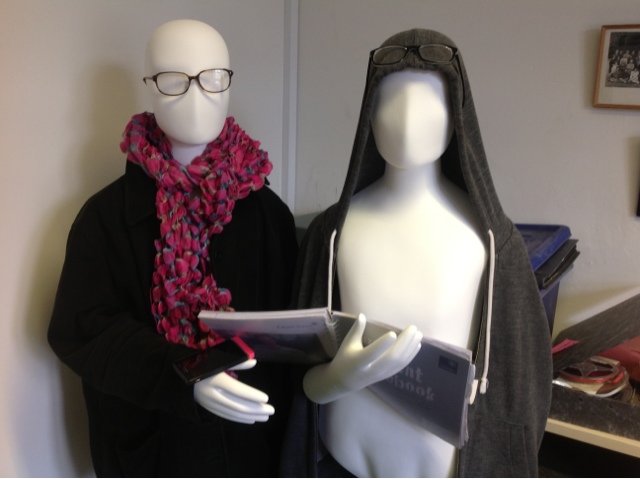
Archie Archive and Little Archie, modelling our coats...

Conservation issues vary with the rest of the archive materials. During office hours, care needs to be taken with food, drink or greasy fingers; we can't risk the documents when it comes to careless handling. Some of the postwar papers, from the early days of Newton Park, are copies of letters and were produced on very fragile paper. There were paper shortages at this time, and so copies were produced on tissue-thin fragments. Many of ours were filed at the time, in bulky bundles, held tightly in one vulnerable corner by a brass split pin, which has long since rusted in position. The papers now need to be removed, but this risks further damage in the process.

Tissue thin paper, in a bundle of letters from May 1945
Other issues surround the manner in which documents were produced at the time, and items such as glue, sticky tape and paper clips can themselves damage any papers to which they are attached.

A photograph of Thelma Willoughby, in the photograph album she kept of her years at Newton Park. The album was passed to the university after her sudden death in a bookshop a few years ago. The album contains a wonderful record of the years 1949-1951.
But what shall we do with that paperclip, rusting away in the corner?
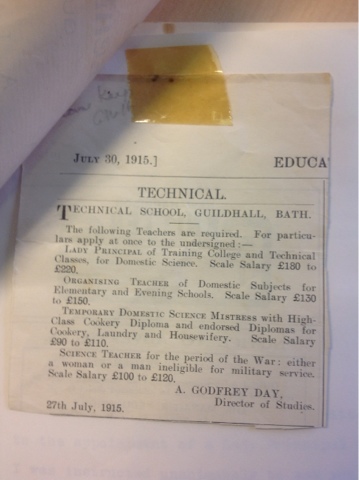
Ancient sticky tape? The cutting is from 1915, but it was taped into this scrapbook much later. Removal will mark and possibly also damage the paper.
Some of the long college photographs are rolled so tightly, they can barely be unrolled. Doing so is an exercise in patience, as previous owners of such photographs have discovered. Some have come to us cracked and damaged, especially at the ends.

Domestic Science College photograph 1937. Like a coiled spring, it won't unroll beyond this !

Collections such as albums and scrapbooks are often best left intact, whatever their condition, since handling or dismantling will not only damage them further, but change the nature of the grouping. Two overstuffed scrapbooks exist of Principal Mary Dawson's early years at Newton Park, compiled by a good friend and supporter. They represent the challenges and triumphs of those early years in a way which is unique, so we will just handle them with care!

Mary Dawson's scrapbook, kept by her friend. A treasure trove of memorabilia from 1946 

Some documents are well beyond our scope and skills, and the 19th century parish maps which once belonged on the Gore Langton estate had to go to the expert conservators at Wiltshire and Swindon History Centre. The repaired maps look great, and one now hangs in the Main House reception at Newton Park, for everyone to enjoy.

Estate Map of Newton Park, beautifully flattened and restored - well, all the pieces that were saved over the years, anyway...

Finally, our Conservation adviser, Emma Gatehouse told us the most important rule to bear in mind when working with any kind of archive document, and one which is used by all collections, however big or small, important or humble. (Especially useful when funds, time or space are short!) 'The Three C's' - namely Caution, Compromise and Common Sense.

And now, time to tackle those rusty split pins....


Wednesday, 27 March 2013

Digital Archives versus Real Life

In a recent blog I talked about scanning, and how the digitisation of archive materials has changed the world of research. (Take another look! http://bsuarchive.blogspot.co.uk/2013/03/scanning-scanning-and-more-scanning.html) 

There is a good deal of dispute, amongst researchers, historians and in the archive world, about whether online or real access is 'better'. But as with many other areas of life, there are pros and cons to both access routes.

A digitizing challenge: this scrapbook charts the early years of Newton Park Teacher Training college, and was the property of Principal Mary Dawson. All of the items are glued in, and the whole book is rather fragile.

There is more material available to view online with each day that passes. Recent developments have seen the digitisation of Queen Victoria's diaries, as well as Blitz maps of London, made widely available for the first time. As well as offering these resources to a far, far greater number of people, it is also the means to protect the original documents from over-handling.

As a researcher, returning to university as a mature student just four years ago, I was staggered at the sheer number of easily accessible resources available through the university library. Here was a gold mine of information, to be found at my fingertips, via the computer. I read ancient books, opened Georgian newspapers and looked at famous and obscure paintings right down to the smallest brush strokes.

Domestic Science College students, 1916. This photograph is very evocative  of the era, with women students reflecting masculine styles of dress and stance. The image is also stained with dirty fingermarks and battered at the edges

A visit to a 'real archive' and the handling of real documents naturally takes this fascination onto an even more thrilling level, but for me, this initial online access prepared the way, enhancing my interest in primary sources.

I had already fallen under the spell of archive materials via technology when I was given the opportunity for a placement in a real archive. And there, in the search room of the Wiltshire and Swindon History Centre in Chippenham, Wiltshire, I fell under the spell of old documents completely. The feel, and above all the intoxicating smell of them, can transport you to an entirely new level of appreciation of the past. I'll never forget the letter from a First World War soldier and the pressed flowers which fell out as I unfolded it.

The placement with Wiltshire and Swindon History Centre, and everything I learned there, has informed the work we do here at BSU Archive. The ongoing digitisation of our documents will mean access for all those who wish to know more about the history of the university. This in turn will lead to greater research into the many aspects of the past, as yet uncovered. It will also mean that more people could have the opportunity to handle the real documents and, through oral history testimony, to listen to the real people who have experienced life in these places over the years.


Group photograph of Domestic Science students, 1937. This image has been stored, rolled, for many years, and  is difficult to unroll. Another challenge to come...


The first Newton Park students, 1946. Those who have been interviewed from the late 1940s  recall  the simpler pleasures they enjoyed, and a feeling of unity having lived through the deprivation of the war years. 


Want to find out more about the Wiltshire and Swindon History Centre? Website available at  http://wshc.eu/our-services/archives.html