Showing posts with label Gore Langton. Show all posts

Wednesday, 11 September 2013

Guest Blog Post - Laura

This week, Laura gives her view of the last few months:


'Listen! The wind is rising, and the air is wild with leaves,We have had our summer evenings, now for the October eves!' (Humbert Wolfe)


So, summer is coming to an end and autumn is taking over, creating beautiful scenery for us to admire on our way into the office (armed with jumpers and scarves) but before I begin my final, scary, year at university, I wanted to take the time to reflect on what we have been doing over the summer, and what I have discovered so far. 

Since my first trip to Corsham on the 17th April, I have not only learnt a lot about working at an Archive, but also about the history of Newton Park and its residents, from the Gore-Langton family, to the students who walk around the campus today.

This summer we have been busy, from completing our exhibition preparation to cataloguing each and every item in our office! In between these two jobs, we have been transcribing oral interviews, as well as going to a number of re-unions organised by the Alumni Association at the university. My first ever day at the office was spent cataloguing, and though over the summer we changed our method, it is still one of the most important tasks we do, as it ensures easy and straightforward access for future historians looking to find specific documents relating to their research. It has meant many hours sitting at a computer screen and describing and numbering each and every item we have, before placing them into special archival-standard storage boxes.
Cataloguing - so satisfying once its done!
As I joined the Archive in April most of the oral interviews we have had already been conducted, though I did have the opportunity to sit in on one of them, which was fascinating, to meet somebody and have them share their experiences of what it was like to come to the university over thirty years ago. Writing transcriptions are also interesting, especially if you were not at the actual interview, as you get to hear people’s stories and memories, however the actual transcriptions are extremely time consuming, as on average it takes seven hours to transcribe one hour of audio! However despite how time consuming they are, they are interesting, and it is an invaluable skill to gain, especially as it has increased my typing speed significantly!
July Reunion at Newton Park
July Reunion - meeting new friends, re-visiting old haunts
Having heard the memories of many individuals through listening to their oral interviews, it was a fantastic opportunity to join some of them at their re-unions in July. Whilst we were there Hayley, Kate and I were asked to talk about our experiences of being students at Bath Spa, which was great, as it meant we reflected on our time here, and realised what a lovely place this university is. I really enjoyed talking to the alumni, hearing their stories as well as telling my own! One particular memory that we learnt had been shared by many students of the university, despite their era, was sunbathing on the roof! Having overheard a lady talking about how she used to climb onto the roof of stable block to catch some rays, Hayley felt obliged to share with her that I, also, found my way onto a balcony area of my halls to catch some sun. Obviously some things never change!


Tuesday, 7 May 2013

Bugs, damp and rusty pins: Conservation challenges in the archive

Here in the archive, although most of our documents are relatively modern (20th century onwards) we still have to consider the potentially damaging effects of the environment.

The 'nine agents of deterioration' is a theme very familiar to Conservator Emma Gatehouse, a Bath Spa graduate who now works for the National Trust. She developed an interest and expertise in this area during MA Heritage Management studies at BSU, and has advised the archivists here on aspects of preservation and collections care. (By the way, those nine agents of deterioration are fire, water, loss, physical, chemical, biological, light, humidity and temperature)

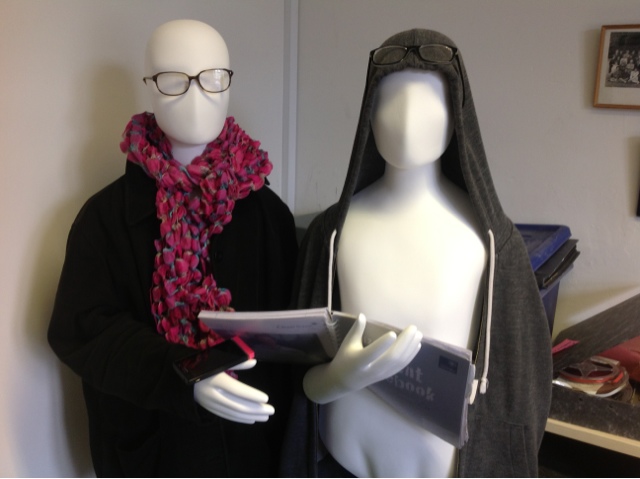
As well as being an archive storage area, our room at Corsham Court is also a working office, so the rather cool temperature has to be accommodated through extra jumpers for the archivists! It also means that we are surrounded by archive quality storage boxes, and in the corner, our two display mannequins stand, awaiting their chance to show off any period clothing. On a day to day basis, 'Archie' and 'Little Archie' model our coats and scarves for us, and move their positions according to who was last in the office (or do they actually move independently...?) If anyone is ever in the office on their own, the mannequins either keep you company or give you the creeps, depending on your frame of mind...
Archie Archive and Little Archie, modelling our coats...

Conservation issues vary with the rest of the archive materials. During office hours, care needs to be taken with food, drink or greasy fingers; we can't risk the documents when it comes to careless handling. Some of the postwar papers, from the early days of Newton Park, are copies of letters and were produced on very fragile paper. There were paper shortages at this time, and so copies were produced on tissue-thin fragments. Many of ours were filed at the time, in bulky bundles, held tightly in one vulnerable corner by a brass split pin, which has long since rusted in position. The papers now need to be removed, but this risks further damage in the process.

Tissue thin paper, in a bundle of letters from May 1945
Other issues surround the manner in which documents were produced at the time, and items such as glue, sticky tape and paper clips can themselves damage any papers to which they are attached.

A photograph of Thelma Willoughby, in the photograph album she kept of her years at Newton Park. The album was passed to the university after her sudden death in a bookshop a few years ago. The album contains a wonderful record of the years 1949-1951.
But what shall we do with that paperclip, rusting away in the corner?
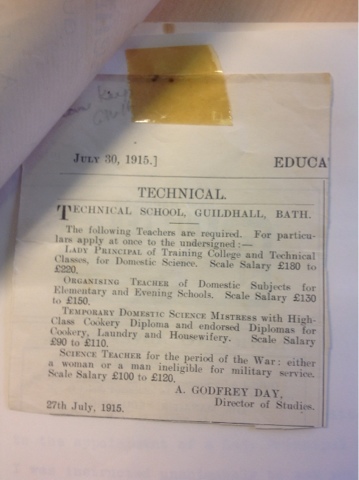
Ancient sticky tape? The cutting is from 1915, but it was taped into this scrapbook much later. Removal will mark and possibly also damage the paper.
Some of the long college photographs are rolled so tightly, they can barely be unrolled. Doing so is an exercise in patience, as previous owners of such photographs have discovered. Some have come to us cracked and damaged, especially at the ends.

Domestic Science College photograph 1937. Like a coiled spring, it won't unroll beyond this !

Collections such as albums and scrapbooks are often best left intact, whatever their condition, since handling or dismantling will not only damage them further, but change the nature of the grouping. Two overstuffed scrapbooks exist of Principal Mary Dawson's early years at Newton Park, compiled by a good friend and supporter. They represent the challenges and triumphs of those early years in a way which is unique, so we will just handle them with care!

Mary Dawson's scrapbook, kept by her friend. A treasure trove of memorabilia from 1946 

Some documents are well beyond our scope and skills, and the 19th century parish maps which once belonged on the Gore Langton estate had to go to the expert conservators at Wiltshire and Swindon History Centre. The repaired maps look great, and one now hangs in the Main House reception at Newton Park, for everyone to enjoy.

Estate Map of Newton Park, beautifully flattened and restored - well, all the pieces that were saved over the years, anyway...

Finally, our Conservation adviser, Emma Gatehouse told us the most important rule to bear in mind when working with any kind of archive document, and one which is used by all collections, however big or small, important or humble. (Especially useful when funds, time or space are short!) 'The Three C's' - namely Caution, Compromise and Common Sense.

And now, time to tackle those rusty split pins....