Showing posts with label Newton Park. Show all posts

Thursday, 30 July 2015

BSU Archive Summer Module 2015

After a few weeks' break, some of our students have returned to university, giving up part of their summer vacation to complete an extra module. Ashley, Tom and Izzy are here for three weeks, preparing for a big event which is happening at the end of August.

I'll let them tell you more:

Ash:When we returned to the archive for the summer module  there were many items that required alterations to their catalogue entries. Before we left for the summer holidays a new system had been created which inserted another sub-level into the category of ‘BSU_2’ items - the institutional documents.

As the institutional documents comprised the largest section of our collection by far, it was decided that they needed to be divided up for the sake of organisation. Six groups were devised in order to sort out the collection; BSU_2_1 for Bath College of Domestic Science,  BSU_2_2  for Newton Park College, BSU_2_3 for Bath College of Education,  BSU_2_4 for Bath Spa University College and Bath Spa University and BSU_2_5 for Bath Academy of Art. Our aim for creating these sub-categories was to ensure that individual documents and items will become easier to locate.

What this meant was that all of the catalogue entries had to be printed out (in red ink due to a shortage of black!) for the edits to be made. Whilst doing this, it was felt that two birds should be killed with one stone and we simultaneously checked for errors and omissions in the catalogue and then corrected and completed them. The end process would be a catalogue sheet that had a fuller description of the item and an updated reference number. These catalogue sheets were then tucked into the boxes where their corresponding items with were kept with a pink sticky label, ready for the final step.


After the rough alterations were made on the printed catalogue sheets they then needed to be typed out on to the catalogue entries on Google Drive on which they are stored electronically. Once this had been completed, the pink sticky label would then be marked with a tick so we knew that the box was completed. Over the course of the first week, everything was edited both physically and electronically and has now been returned to the shelf. Its a long process, but satisfying when you see the end result. Its also helped us to find the items we need for the Alumni Reunion weekend, which Tom describes below.

Tom: The paramount event of our Summer Module will be the Bath Spa University Archive exhibition at the Alumni Reunion weekend. The alumni event will be bringing back numerous former students to the Newton Park Campus; the heart of the university. The Archive has been dedicated to the preservation of our history and has been steadily accumulating a wealth of documents and artefacts from the past institutions from which we grew.The alumni presents us with a unique opportunity to interact with the human elements of our history and we hope to trigger a few memories 

The "how" of our exhibition at the Alumni event is still in the creation process. It is important remember that the guest list includes students who graduated from 2014 all the way back to 1955, and that most of the guests would have studied in now defunct institutions such as the Bath College of Domestic Science, Bath College of Higher Education and  Bath Academy of Art, which have been amalgamated into a single institution over the decades. This presents us with the challenge of trying to make our exhibition relevant to a wide range of ages and experiences. 

So far, we have found photographs, prospectuses, paintings, newspaper cuttings and more from our collection of hundreds of catalogued items and documents. The emphasis for which items we shall display will revolve around student experience rather than administrative work, so our display can resonate with the former students. 

Finally, we have also got a leaflet for our exhibition under way, currently we have been acquiring resources electronically to use for it, So far we have acquired numerous antiquated photographs to be used to improve the aesthetic qualities of our leaflet. We intend to advertise the archive (in the hope that some ex-students might want to donate any of their old items to the Archive) as well as give a brief overview of the various previous institutions which are part of our history. Above all the leaflet is designed to advertise the archive and will be geared towards welcoming the former students into a trip down memory lane. 


Izzy: Aside from our primary focus of designing the exhibition, we were able to put into practice our archiving skills by cataloguing new items under the new system. Due to the excess number of items stored under the institution, it was necessary to introduce additional codes in order to differentiate each establishment involved. The team sorted through a number of portfolios and logged photographs and documents under their new allocated codes. These particular files included material relating to the institution; namely relating to the Domestic Science College.

 A personal collection was donated also donated to us; so Ashley, Kate and I carried out a ‘scoping exercise’ in order to gain an overview of what documents and information were included. They belonged to Professor Graham Davis as part of his research into Newton Park, and will eventually be stored in ‘Personal Collections’.
 For myself in particular, a new experience arose to suddenly be advised to be mindful of insects that could potentially harm various materials throughout the archive. We experienced first hand the damage imposed by an unidentified creature, and even came across a silverfish in one of the folders.

It’s been an interesting contrast to my previous archive experience, as I had not carried out any cataloguing tasks in the second year module. The planning involved with setting up the Alumni Reunion Weekend had been the most enjoyable element, especially when coming across names of those attending whilst going through archive material. Sorting through old photographs of students and institutions is personally my favourite aspect of working in the Bath Spa University Archive.

Izzy Watkins, Ash Catt, Tom Buckingham 
3rd Year History students


Wednesday, 25 March 2015

Learning from the Landscape

I'm now in the second year of my PhD, focussing on the themes of citizenship and community during the early years of Newton Park Teacher Training College. My current task is a deep analysis of the archival documents relating to those founding years, under the leadership of Mary Dawson, the first Principal.
'It was recognised that this beautiful landscape must, of itself, educate the students' (Mary Dawson, 1946)
Picture: Kate James

Going through some of Miss Dawson's speeches, one theme repeats again and again. This is the idea that the historical environment of Newton Park was considered a learning resource in itself, in addition to the teaching the students received from their books, lecturers and school practices. 

The built environment and landscape of the park represents over a thousand years of English History. 
Mary Dawson wrote in 1954 that 'there is a sense in which the students are heirs of a rich culture with roots deep in time.' 

Ancient buildings - the stable at Newton Park today
Picture: Kate James
Newton Park gatehouse, where generations have passed to and fro
picture: Kate James
Miss Dawson, as a historian herself, became fascinated to discover as much of the history of Newton Park as she could, and she sought the help of Darlow and Molly Humphries. Professor Humphries, a governor of the college, taught at Bristol University and Molly was the college's own history lecturer. A file of papers accumulated by the Humphries is part of the archive collection, and demonstrates the research methods of the time. Back in the 1950s, each item of information was garnered through a painstaking series of letters or time-consuming visits with uncertain outcomes. Some of Professor Humphries correspondents were helpful, but many are guarded or protective of their sources. Some were even deliberately unhelpful.

Today we can look up digitised archive records instantly; so much has changed in the world of research. Newton Park has changed too, with new buildings and vastly more students, but at its heart it retains all the historical aspects so admired by Mary Dawson, Molly and Darlow Humphries

 Kate James


Wednesday, 21 January 2015

Finding a Home for the Sydney Building

When thinking about constructing a new building for a site, whether it is a university or otherwise, an integral part of that planning process is to consider the question ‘where is it going to go?’. Generally, in the 21st century and particularly in Bath, this kind of enterprise comes with a host of practical concerns of the potential impact that such a building might have on the surroundings.
 Now, we all love our campus here at Newton Park for it’s great beauty and peaceful atmosphere; it’s sparsely built and seems to co-exist with the countryside around it. Much of what we appreciate today of the site is down to the famed 18th-century landscape gardener, Lancelot ‘Capability’ Brown who beautified the grounds for the Langton family who were living there at the time, in what we now know as the Main House. From dainty ornamental trees to the beloved lake, his mark has truly been left on the site, and it is him we have to thank for wonderful views such as these;


The view from in front of Main House (2015).
   It is truly a lovely view. So, you can imagine our bemusement in the archive when we came across two black and white photographs of this exact view here, largely unchanged. These photographs were dated from the 1950's, when Newton Park was home to Bath Teacher Training College, which opened in 1946. However, they had not been left as they were. In some kind of collage, a small drawing of what we would now know as the Sydney Building which is used for accommodation has been superimposed over it.
The view directly in front of Main House.

A view we will be familiar with today (1954).
   Disregarding the imposing presence of the prototype Sydney Building, the view seen in these edited photographs is one that is very familiar to us, even sixty years on. Particularly distinctive is the tree that can be seen in the foreground of both the modern and the 1950's photographs. 

   These two photographs were most likely dated from the year 1954 which is the year that the Sydney Building was constructed. Given some of the notes scrawled on the back of the two photographs, it is likely that these collages were an attempt to visualise how suitable the Sydney Building would be if it were to be placed in this location. What we do not know, however, is exactly who came up with the idea to place the building in such a location, and more importantly, what their motives were for doing so.

   These collages look remarkably similar to images that some building projects generate in the modern day to simulate how the end result of the ongoing project may look. Often, software such as Photoshop will be used in order to create a realistic looking image. Obviously, we know that this kind of opportunity was not available in the 1950's, however the level of detail that the artist has gone to in order to create a realistic image is striking, and gives us a good idea of how the building may have looked, had the decision been approved to place it there.

The Sydney Building (2015).
   Above is the Sydney Building as we now know it, and where it has been for the past sixty years. The location that was decided on allows the campus to retain the same stunning view that it has boasted since the 18th-century, and the serene vision of Lancelot Capability Brown continues to live on at Newton Park.

Wednesday, 2 April 2014

A Special Meeting

In the course of running the BSU Archive, we are lucky to meet a wide range of people who have been involved with parts of our institution over the years.
Often, meeting people and listening to their memories helps to complete the fragmented picture which archive work produces.

By their very nature, archive documents give a piecemeal impression of a time and a place. It can be difficult for historians to form a complete story from the fragments which remain of the past, but by listening to people, and spending time in the field of oral history, we can gain a much fuller picture.

Most recently, three of the team were thrilled to spend a morning with Anne and Bill, two people with much to tell us about life on Newton Park. 

Anne lived in the grounds of Newton Park College in the 1950s, when her father was head gardener. Bill was Mary Dawson's nephew, and he often visited his aunt during the time she was Principal here, spending school holidays enjoying the freedom of the grounds and the attentions of the students.
Bill and Anne, sitting together on the College hostel wall in Newton St Loe, 1950s
Bill and Anne became lifelong friends, and shared a love of the Newton Park surroundings which is evident to this day. 

Our current students, Carol and Hayley, had a great time, chatting and sharing experiences of their own time here. There was much to discover from one another, not least the ways that building use has changed, and the amount of development there has been over the years. Anne showed us the house she lived in with her parents, which is now the small office suite at one end of the Stable. She described her garden and the interior of the house to us, and reminisced about the places in the grounds and around the lake where she used to play. In those days, there were around 200 students, and the relatively small community were able to be much more familiar to one another than we can possibly be today. 

Bill, with the portrait of his Aunt

Bill enjoyed the chance to walk around the lake, and showing his wife the place that she had only ever heard about. She too was impressed that, despite new buildings, the landscape retains its beauty, especially near the lake and looking back towards Main House. This is a theme which comes up again and again when people revisit. (Bill's dog appreciated the walk around the lake too!)

Wednesday, 5 February 2014

Timeless magic: the black and white photograph.

Recently at the Archive we have received two boxes of materials from the depths of the Bath Spa Library containing all manner of interesting documents, objects and images. This week's box provided us with a rich collection of beautiful black and white photographs which we have fallen in love with, and our favourites have been shared below. The photographs show Newton Park students looking effortlessly glamourous when taking part in sports activities, science and art classes and agricultural studies. This has led to a discussion here at the office about the cyclical nature of fashion and how a simple lack of colour can aid to creating an air of class.

As we are now a wholly female team, our conversations can often drift towards what clothes we've seen recently and almost always leads to one of us finding the item online to get the approval of the others. Whilst this used to be confined to lunchtime chit-chat, the introduction of more materials provides us with new and interesting photographs to look through, and it seems that now our conversations about clothes are inspired by a particularly nice jumper, skirt or pair of shoes that a student is wearing in the images we're studying. In light of this recent discovery, I believe that the time we spend each week comparing items online, planning outfits and reminiscing about how similar things were in fashion when we were children all count as historical research! 

Despite how similar our tastes may be with our 1950s' counterparts, one can't help but feel that when comparing photographs from my own university life with the ones we get to enjoy at the Archive, mine will appear much less glamourous. This could be due to the magic of the black and white photograph, or perhaps we live in a less glamourous time! Nevertheless, that we covet the A-line skirts and gingham dresses of our former students shows yet again that we are not so different from our past generations after all, an important lesson that we are reminded of each week when we come to the Archive and delve into our collective past. 

Racing on the lake: students enjoying the lake at Newton Park

Biology class: students taking measurements for tree shapes.

Art class: two students sketching the impressive Main House.


Agricultural studies: a student working in the walled garden.

Guest Blog by third year Historian, Hayley Crymble

Wednesday, 29 January 2014

Dances, Dates and Writing Home

As a new member of the Archive team here at Corsham Court, I was excited to see some more of the collection this week. I really enjoyed reading the letters of Vivianne Ollerearnshaw, who studied on the teacher training course at Newton Park from 1951- 53. Her interview and the letters which she kindly gave to the Archive cover her two years at the college, and provide a wonderful glimpse into life as a student at that time.

During her first year Vivianne lived on the top floor of No. 19 of the Royal Crescent, along with 8 other girls. They shared one big bathroom between them and ate in the large basement; 'our first meal was rabbit stew, which was gorgeous, and custard with banana in it which I shall never forget because we were rationed, we never had enough to eat at home.' In her second year Vivianne lived at Newton Park, in Main House. The had 'a huge breakfast, a huge dinner and a huge supper and tea' everyday in the East Wing, which today is a small cafe. I love the little openings into the details of her life as a student; among other things Vivianne writes to her parents about playing hockey and netball matches between Newton Park and The Elms (P.S. We've won the netball match!'), about going to see Wuthering Heights 'with Lawrence Olivier in' and also about holidays; 'For the Coronation we get not far off a week!'.


'Wuthering Heights will be at Bath next weekend, with Lawrence Olivier in. I've seen it once, but would love to see it again if time.' 


Many of her letters are signed with 'xxxx' and use shortenings such as 'if poss'. This is surprisingly similar to texts and informal emails today- my friends and I use them! In one of the letters, Vivianne is asking her parents for references. The language used seems quite abrupt, and as with the similarities to texts mentioned above, this reminded me that letters were the main form of communication (apart from the telephone', so in a way they did the job of what texts and emails do now. On the other hand, one of the main differences is that many were written over several days. The envelopes have very readable postmarks, unlike today, and the range of stamps is interesting.

Her handwriting is very twirly compared to how my generation were taught to write!

Another thing that surprised me is that the term 'going out' was also in use then. In Vivianne's time it often meant going to dances; she writes about the Weston in Bath ('a little dance place') and about a Valentine's Ball at Bristol University, whereas now 'dances' is clubbing! A little later she wrote about refusing to see 'a partner', meaning a male dancing partner, because she 'musn't go out this term'. I think this shows how some phrases have become outdated, while some are still very much in use amongst people my age. And now that 50s style is back in fashion, it makes me think that maybe some things about youth culture never really change!

By Alice Meigh, 2nd year student at Bath Spa University

Wednesday, 18 September 2013

Guest Blog Post - Adam

"In much of society, research means to investigate something you do not know or understand." Neil Armstrong

In this blog I will be talking about research and its possible links to the Archive.

Research is very useful for an Archive as it helps to expand the material you already have, can help to open new lines of enquiry and often provides answers for questions that come up whilst looking at the material in the Archive. It is also useful for the Archive as it can allow you to locate material that can be found in other archives in the area. As a student studying History, it is a very important and necessary skill that can help in Third Year when undertaking a dissertation, which heavily depends on research to be successful.

Map of the Atlantic Slave Trade

I am undertaking a dissertation based upon the Atlantic Slave Trade or simply ‘The Trade’ and Saltford Brass Mill which will focus on how Bristol, Saltford in particular, benefited from the brass trade and the Slave Trade. It will also look at the connection between brass and slavery to shed light on the little known story of the first part of the Triangular Trade. The Coster family owned the Saltford Brass Mill and also co-owned 6 slave ships and form the basis for the dissertation. As a result of owning the brass mill and co-owning slave ships, the Coster family were making money from the trading of goods to the African tribes, transporting of slaves from Africa to America and the shipping of raw materials from America back to Bristol.
    
The Coster family was not the only family involved in the Slave Trade. Another family involved was the Champion family, owners of the Warmley Brass Works, and were known to be involved in the Slave Trade. It was William Champion (1709-1789) who led the Warmley Brass Works into bankruptcy in 1769.    

Thomas Coster (1684-1739), owner of Saltford Brass Mill

The Merchant Venturers evolved from a Guild of Merchants which existed in the 1200s. They managed Bristol’s harbour from the 16th Century until the early 19th Century. During the 18th Century, the Merchant Venturers became involved with shipping of manufactured goods to Africa and sugar, molasses and rum from America to Bristol.

Merchant Venturers Coat of Arms

The Merchant Venturers owned many of the docks in Bristol and so must have made money from the ships that took the goods to Africa. 

We have read that the Langton family of Newton Park had connections to a shipping business on the ‘Welsh Back’ in Bristol and that it created the wealth the family had. The 'Welsh Back' was where trade with Wales took place, as goods from, and for, South Wales were loaded and unloaded onto sailing barges. As the map below shows, the 'Welsh Back' is near Queen Square (built between 1700 and 1718) where some of the house were built by people linked to the Slave Trade. Could the 'Welsh Back' have been used for the shipping of slaves to Wales or the shipping of brassware to Bristol for the buying of slaves in Africa?

Map of Welsh Back, Bristol Docks

With the house at Newton Park being built in 1761 by Joseph Langton, whose brother Thomas was a Mayor of Bristol and a Merchant Venturer, could it be argued that the Langtons were involved in the Trade? Where did their wealth come from? Did the Langtons still possess a shipping business on the 'Welsh Back' during the height of the Slave Trade? Did the Langtons have any contact or dealings with the Coster or Champion families? What were the Langtons shipping to and from South Wales? Were the Gore-Langtons supporters of the abolition of the Slave Trade in 1807? Were the Gore-Langtons supporters of the abolition of slavery in 1833?

By continuing with this dissertation I hope to be able to have light shed on these questions and hope to be able to provide help to the Archives. Answering these questions can lead to more material being added to the Archives and can lead to other paths of research as a result. Without research an archive will not develop and will not gain any new information besides what may be donated or left to them.   

Monday, 24 June 2013

Buildings Old and New

Recently, we took advantage of an opportunity to view the newest building on the Newton Park campus, and took the 'Work So Far' tour offered to students and staff. This new academic building has been under construction since 2011, and will be opened in 2014.

From an archivist's point of view, it was fascinating to see the latest expression of academic life which has taken shape on this spot. Richard and I have worked on the archive together since the building work began, and have researched and learned the history of this site as the university landscape alters in front of our eyes. There have been many things on this spot over the years, and many people have come and gone...


The Newton Park site is an ancient one, and remains from over 2000 years ago have been found here. Fragments of Roman floor tiles, discovered during post-war renovation of the Castle building, now reside in the vaults beneath the Roman Baths, where the county archive stores are located. Down there in the tunnels, they lie amidst the stones, carvings and ephemera of centuries-worth of Bath history. (By the way, you can go on tours down there - and they're free to local residents with a free Discovery Card - well worth going! For more details, see the website http://www.romanbaths.co.uk/whats_on/events/events_calendar/tunnel_tours_and_store_tours.aspx

The Newton Park estate was granted to the Bishop of St Lo (hence 'Newton St Loe') one of William of Normandy's men, after 1066. The Manor is mentioned in the Domesday Book. This family, and then the Nevills, developed the fortified manor house, part of which still stands and are still in daily use. In 1666 the estate was then sold to the Langton family, who, by the 1760s had built the grand house which sits at the heart of the Newton Park campus today.

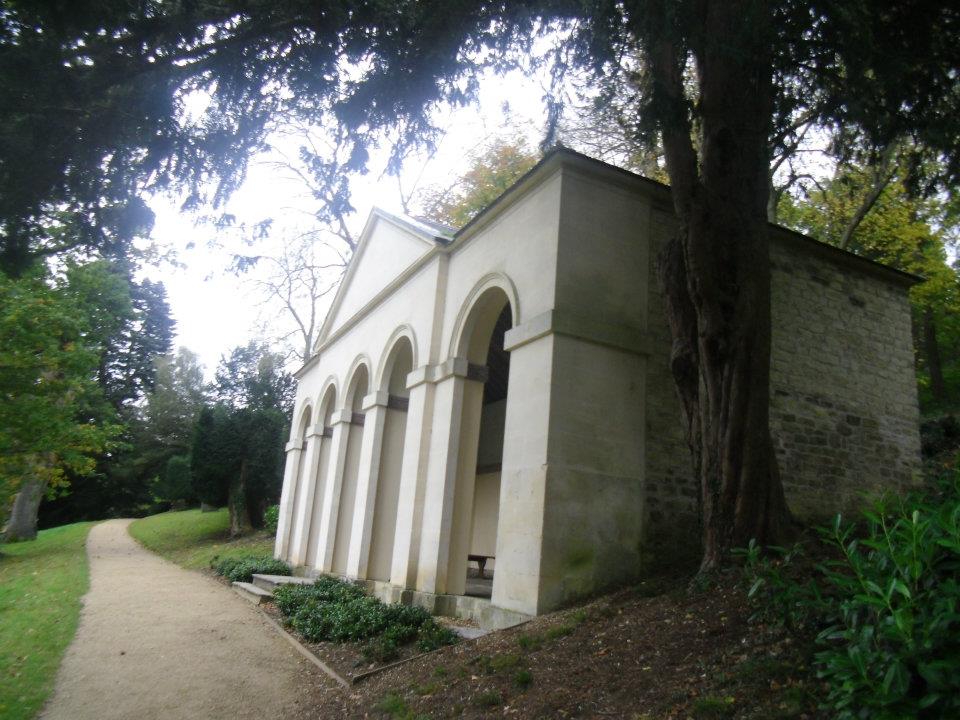
Joseph Langton completed the development of his new home, with newly landscaped grounds. The work of Lancelot 'Capability' Brown, these grounds perfectly complimented the house, and boasted lakes, a garden temple and all the trappings of a country gentleman's lifestyle.

A new view of Capability Brown's landscape
This landscape is, somehow, rediscovered through the medium of a brand-new, state-of-the-art academic building, as from within, some beautiful new vistas are opened up. From each floor, the wide windows present different angles; from the top floor it is possible to see 360 degree views, over the main house, the landscape and the surrounding woods. It is spectacular.

The view across the valley towards Kelston Round Hill
In the 1940s, Newton Park passed out of the ownership of the Gore Langton family, and was purchased by the Duchy of Cornwall. It was leased to Bath City Council, who opened it as a women's teacher training college. Gradually over the years, it developed, became independent, and grew into Bath Spa University. It continues to develop - hence the new building, to be followed soon by the new student accommodation. In fact work on these halls of residence began this month...watch this space.

Richard captures new memories
The new academic building is positioned on a spot which has witnessed a great deal. In the 1940s there was a small orchard here, and beside it,  a tennis court was constructed. Both of these still existed until the 1980s. Adjacent to these, the first men's hall of residence - Hungerford Court - took shape; it opened in 1962.

Among the trees - the view from the first floor
These have all formed the foundations of our shiny new building. This seems very fitting. Former students and staff have returned to Newton Park and told us their stories of life in and around the rooms, the corridors and the grounds. Some were sad that the old things had to go to make way for the new, others were accepting of change and the need to move ever-forward. And of course, there are some people who would never want to return to their old haunts, preferring to hold their memories intact. At the archive, we have sympathy with all these views, and only hope that we will always do justice to memories, in all their forms.

Towards Newton St Loe and Bath
On the day Richard and I saw inside the new building, most of the people looking around were taking photographs, using cameras, phones or tablets. We were all capturing fresh memories, ready to pass on to the people who follow us...

Wednesday, 15 May 2013

The New and the (Not So) Old

This week Hayley and Laura have written the guest post and have decided to hold an interview so that you can get to know the two archivists a little better. Hayley has been working at the Archive since October 2012 and Laura is our newest recruit, starting in April 2013.

How did you come to work at the BSU Archive? 

Hayley: I selected the Humanities at Work module for my second year of study as I want to work at the Imperial War Museum as Education Officer and felt that I should start gaining experience of working within active historical environment. I was given the choice of working at the Archive (then known as the Newton Park Project), working on digitisation for Bath in Time or at an excavation project with connection to the Roman Baths. I chose to work at the Archive as working on a brand new project in which I got to meet past students and staff of the institution I studied at sounded fantastic. 

Laura: I knew Hayley before starting at the Archive, and it was her passion and interest in what they were doing that really got me interested, especially when she would sit and tell me things about the Gore Langtons and the history of Newton Park and Corsham Court. I already followed the BSU Archive Twitter feed https://twitter.com/@BSUArchive , so had a little understanding of what had been going on, so as soon as I found out about the summer module I contacted Bobby who seemed more than happy to let me get involved and join Hayley and the team here at Corsham Court the next week to see if I was interested.

A view of the East Wing of Main House.

Did your first impressions of Newton Park encourage you to find out more about the history of the institution?

Hayley: Definitely. I had not visited the university before I came to live and study in Bath. I was stunned by the beauty of the buildings and landscape of the campus and my inner historian wanted to find out more, but I didn't know where to get information. When the opportunity to become involved in a project that would teach me more about the institution whilst providing me with experience of a working archive arose, I grabbed onto it with both hands!

Laura: I came to the university in 2010 to visit a friend for a week, and fell in love with the campus and its grounds. Once I then started at university I learnt a little more about the history of the grounds however it wasn't until Hayley started telling me about her work at the Archives that I realised just how much history there was surrounding the estate, and ever since then I have wanted to be a part of finding out more!

The Garden Temple

What interests you most about working at the BSU Archive?

Hayley: Of the wide scope of work that we do here, for me the oral history section of the Archive is the most enjoyable part. Whilst we have been given some fantastic donations of former student’s work and some beautifully crafted scrap books, I feel that physically interviewing past students and staff has a competitive edge when regarding personal accounts of the past of the institution. During the interviews these people share their memories and seeing their facial expressions and hearing their tone of voice can affect your impression of what they’re talking about. The human history is made more real when you are face to face with someone who used to sleep in the room you now have seminars in!


Laura: I didn't have any experience with regards to oral history and working with in an Archive before,  other than what I had studied as part of my course, so I am really interested in finding out more about how it works, and the logistics of actually putting together an Archive, as it all seems very complicated to me at the moment. What I am most excited for right now is meeting people who went to the university before I was even born, and hearing their stories about what life was like, as well as having access to pictures of what the campus was like before. I am also really interested in the family history behind both Newton Park and Corsham Court, and despite reading quite a bit about them, would love to find out some more. 


Hayley and Laura having a look at the Technical School's minute book from 1905.

Tuesday, 7 May 2013

Bugs, damp and rusty pins: Conservation challenges in the archive

Here in the archive, although most of our documents are relatively modern (20th century onwards) we still have to consider the potentially damaging effects of the environment.

The 'nine agents of deterioration' is a theme very familiar to Conservator Emma Gatehouse, a Bath Spa graduate who now works for the National Trust. She developed an interest and expertise in this area during MA Heritage Management studies at BSU, and has advised the archivists here on aspects of preservation and collections care. (By the way, those nine agents of deterioration are fire, water, loss, physical, chemical, biological, light, humidity and temperature)

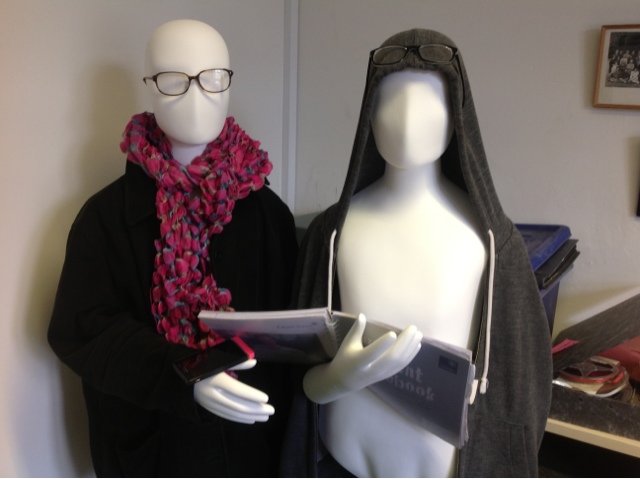
As well as being an archive storage area, our room at Corsham Court is also a working office, so the rather cool temperature has to be accommodated through extra jumpers for the archivists! It also means that we are surrounded by archive quality storage boxes, and in the corner, our two display mannequins stand, awaiting their chance to show off any period clothing. On a day to day basis, 'Archie' and 'Little Archie' model our coats and scarves for us, and move their positions according to who was last in the office (or do they actually move independently...?) If anyone is ever in the office on their own, the mannequins either keep you company or give you the creeps, depending on your frame of mind...
Archie Archive and Little Archie, modelling our coats...

Conservation issues vary with the rest of the archive materials. During office hours, care needs to be taken with food, drink or greasy fingers; we can't risk the documents when it comes to careless handling. Some of the postwar papers, from the early days of Newton Park, are copies of letters and were produced on very fragile paper. There were paper shortages at this time, and so copies were produced on tissue-thin fragments. Many of ours were filed at the time, in bulky bundles, held tightly in one vulnerable corner by a brass split pin, which has long since rusted in position. The papers now need to be removed, but this risks further damage in the process.

Tissue thin paper, in a bundle of letters from May 1945
Other issues surround the manner in which documents were produced at the time, and items such as glue, sticky tape and paper clips can themselves damage any papers to which they are attached.

A photograph of Thelma Willoughby, in the photograph album she kept of her years at Newton Park. The album was passed to the university after her sudden death in a bookshop a few years ago. The album contains a wonderful record of the years 1949-1951.
But what shall we do with that paperclip, rusting away in the corner?
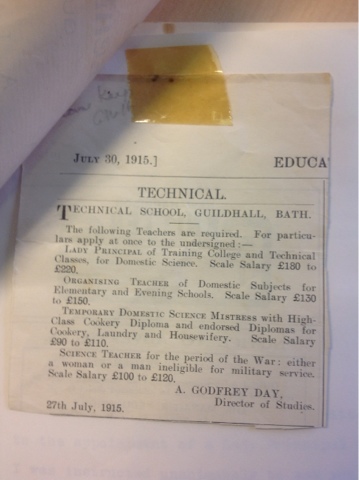
Ancient sticky tape? The cutting is from 1915, but it was taped into this scrapbook much later. Removal will mark and possibly also damage the paper.
Some of the long college photographs are rolled so tightly, they can barely be unrolled. Doing so is an exercise in patience, as previous owners of such photographs have discovered. Some have come to us cracked and damaged, especially at the ends.

Domestic Science College photograph 1937. Like a coiled spring, it won't unroll beyond this !

Collections such as albums and scrapbooks are often best left intact, whatever their condition, since handling or dismantling will not only damage them further, but change the nature of the grouping. Two overstuffed scrapbooks exist of Principal Mary Dawson's early years at Newton Park, compiled by a good friend and supporter. They represent the challenges and triumphs of those early years in a way which is unique, so we will just handle them with care!

Mary Dawson's scrapbook, kept by her friend. A treasure trove of memorabilia from 1946 

Some documents are well beyond our scope and skills, and the 19th century parish maps which once belonged on the Gore Langton estate had to go to the expert conservators at Wiltshire and Swindon History Centre. The repaired maps look great, and one now hangs in the Main House reception at Newton Park, for everyone to enjoy.

Estate Map of Newton Park, beautifully flattened and restored - well, all the pieces that were saved over the years, anyway...

Finally, our Conservation adviser, Emma Gatehouse told us the most important rule to bear in mind when working with any kind of archive document, and one which is used by all collections, however big or small, important or humble. (Especially useful when funds, time or space are short!) 'The Three C's' - namely Caution, Compromise and Common Sense.

And now, time to tackle those rusty split pins....


Monday, 29 April 2013

Mrs Thatcher's Generation

Whatever your politics, you will not have been able to ignore the death of Margaret Thatcher, a woman we all know something about. Whether through direct experience, or through the stories which have been published over the past weeks, we all know something of the life, work and achievements of this country's first woman Prime Minister.

Mrs Thatcher's generation? The Class of 1949 at Newton Park
I can see many parallels between women like Margaret Thatcher and the generations of former staff and students we have interviewed. These interviewees are predominantly women, as in the past we produced mostly women teachers. And because these women trained to be teachers, they had careers, some long, some short.  Some married, some had children. Most continued to work to some degree or another. They are the generations who grew up in the shadow of war, who attained a certain standard of living, promised in the aftermath of the thirties and forties in Britain. This cultural background coloured their opinions, their upbringing and their education, in a way which we struggle to understand today. 
1948: A student attends an interview with Miss Dawson, accompanied by her parents (and younger sister?) . Newton Park was not ready for use until 1949, so may only have been visited for the interview and annual Commemoration Day in June.

It seems to me that people then got on with things in a different way. Instead of fussing about things, you put your head down and worked hard, since, by contrast to wartime conditions, life was a good deal better. The privations of their youth (wartime restrictions and so on) coloured their future lives. My generation ridiculed this tendency; we certainly didn't understand it.

During the oral history interviews, I've been ready to hear about issues of feminism, of equal rights, and of unfair treatment towards working women. Although on one hand it seems a little disappointing when these things are absent, it also makes me feel humble to know that in the 1950s and 1960s, you proved yourself by simply getting out there and getting on with it. The only 'complaint' was around the firm expectation that a woman teacher should wear a skirt!

Sue, at Wellow Station on her way to teaching practice, early 1960s.
(Photo: S.Tewson)
I myself come from a family of similarly strong women, who ran businesses with their families, and tackled any tasks which happened to need doing. I'm not sure if my feisty grandmother would have described herself as a feminist (or whatever the term would have been for her generation) but she certainly expected people to work hard and make a difference to their lives - the difference being dependent on the amount of hard work one was willing to put in. This attitude, born of a particular time and place, is perhaps now passing from our culture (discuss?!)

Famous people like Margaret Thatcher will have their stories told many times. The history books will be filled with details, opinions and analysis of the part they played in the nation's story. Not so the thousands who got on with the job every day, and lived through the same years. 

Oral History is a way to counteract this. By talking to the people who experienced life here, we hope to bring the nuanced details of history to the archival record.

Commemoration Day choir performance, 1964 (Photo: S. Tewson)

We continue to welcome a host of fascinating people to interview. Next month will be the turn of a former Newton Park student from the 1950s and a music lecturer who saw several decades of change in the same setting. Its always a pleasure to hear their words, and we look forward to sharing their stories.


Wednesday, 17 April 2013

Digitisation Doctor Conference

Starting off a series of 'guest' blog entries, the Archive (or at least half of it) had an away day today, and attended a digitisation information event in London. Being from London myself, it's always great to get to go back, particularly for educational/academic visits. I've had the pleasure in the last year of being able to visit the British Library for an Oral History Workshop, for example.

Kate and I went to the Wellcome Trust at Euston, a building which I have passed many times on my travels around town but never had the privilege to visit before. It was a great venue and I must say I loved the modern style of the architecture, a great juxtaposition to the great St Pancras Hotel - or St Pancras Station if you believe the Harry Potter franchise - a few hundred yards away.

The Wellcome Trust was a great venue

I think it's fair to say that we were treated to an outstanding day, my first proper conference of sorts, having attended a number of workshops with my secondary school. The papers were varied but all highly applicable to the developments at the Archive.

I could easily highlight any of the presentations but I want to mention specifically William Kilbride (follow him on Twitter @WilliamKilbride) from the Digital Preservation Coalition. His 'Preservation Planning in 12 Questions' was particularly brilliant and I can definitely see myself incorporating this into my MA in the coming two years. On a personal note I am thrilled to have been accepted on that course and look forward immensely to continuing my studies here at Corsham Court.

These are some great questions that preservation projects would do well to keep in mind... 

I also particularly enjoyed Christy Henshaw (@Chenshaw) who spoke about workflows in digitisation projects. Her flow diagrams certainly took me back to the project modules I did on my ICT A-Level. Memories! Finally, I wish to mention Simon Tanner (@SimonTanner) and his talk on Optical Character Recognition (OCR). It has certainly led me to appreciate the systems available via Bath Spa University's Electronic Services. I cannot help but feel a lecture on this to undergraduates would help them to appreciate the enormity of the scope of putting such resources online, and why currently they cannot hope to be 100% accurate.

All of the talks had some resonance with our project, though, and elements of them all will no doubt feature on our work as it progresses in the next couple of years. It really is an exciting time for anyone associated with the BSU Archive!

There was also time for discussion with the rest of the group, and we were fortunate enough to be able to chat with some representatives of the Collections Trust, based at the Natural History Museum, South Kensington. They opened our eyes to some fantastic funding opportunities available through the European Commission, particularly the Europeana project. This looks like it could have the makings of a fantastic portal for materials across Europe. I highly recommend it to any fellow students or those interested in European history in general. Who knows what one might find there?

The day was made even better with the use of Twitter, allowing members of the group to communicate with the speakers once they had finished. They were also able to post up their slides before they spoke so that we could follow on our connected devices as well as on the projector. For those interested, you can have a look through the tweets using the hashtag #digidoctor. For someone involved with IT, it was an excellent use of social media to help add to an already excellent event. In my opinion it really showcased the power of social media.

Today has certainly got my creative juices going and I can already think of directions to take the digitisation of the project forward, particularly in relation to OCR systems, funding, planning and development of a cataloging and online digitisation system. I have really enjoyed today and once again look forward to helping the project to develop in the future. I could write so much more but I think I leave more detailed specifics (for now!) to my own private reflective blog for the project. Good things come to those who wait...

There was even some time to stop by one of my favourite watering holes in the area before heading back to Paddington for the train to the West Country. As I write we are being delayed by signalling problems, some things really never change! Had a beautiful sunset to bid me a fond farewell from the capital, so it's not all bad news.

From the train coming out of London

I would once again like to point a friendly finger towards our own Twitter presence, @BSUArchive. Please do give us a follow to keep up with our latest news.

Richard

Wednesday, 10 April 2013

Oh...the weather

While we shiver and wait for the spring to arrive, here at the archive office Oral History interviews have continued. We always have to apologise for the coolness of the office itself - but it is an archive after all!

Over the past two years, we have heard from around fifty people, who have either told us, or written down their memories. The majority of these people are former students, and about a quarter were staff members.

Visiting schoolchildren investigate the chicks at Corsham Court. A 1950s  spring scene.
So many people have strong memories associated with the weather, and again and again we have been struck by the way that extremes of weather affect people. Consider our recent experience, and the way that this long, cold winter and late spring has affected those around you. At Bath Spa University, it has certainly played its part, and the third year dissertation students seem to be even more stressed than usual. Normally, by now, they would have been able to shed a few layers of clothes, and perhaps enjoyed that freer feeling that comes alongside spring flowers and birdsong. They are, however, still bundled up, struggling against a bitter wind as they trudge up and down the Newton Park driveway. But the life of the student now is a cold one on the whole; by the time the really good weather arrives, term will have finished and the long summer vacation will have begun.

Outdoor sketching at Monk's Park, Corsham, 1950s
For the former students of Newton Park, or Corsham Court, Sion Hill, or any of the other college venues, there are many memories of long summers, of Commemoration performances in the hot June sun, and of sunlit bicycle journeys along country lanes. This puzzled us at first. Was this the rosy glow of youthful pleasure, seen through the lens of reminiscence?


Then we recalled that in the days of teacher training, before university status, terms were similar to school terms, rather like the PGCE course now. So, happy memories of long warm evenings are very real.

Commemoration Day preparations c 1960s
A staff meeting, on the lawn beside Main House, Newton Park 1960s
It seems that the weather in June was always to be good enough for Commemoration Day at Newton Park  to be held outdoors.  At least this is what the photographic evidence tells us. For the first twenty years of the teacher training college, photographs show the women students dancing in short tunics in the Italian Garden.


Commemoration Day 1958. Local schoolchildren playing in the Primary Garden (which was situated next to Castle at Newton Park)

Dancing display at Newton Park, 1957

Details of Commemoration Day at Newton Park, 1960

That's all for now. I hope the weather improves wherever you are. Here at the BSU Archive office in Corsham, the peacocks are getting extremely noisy, which is a good sign that the warmer weather - and the mating season - is approaching. I interviewed a lady last week, who learned to make a peahen call while she was a student here. She could make the peacocks display their glorious feathers whenever she wanted! What a skill! 

More next week...watch this space!

Kate the Archivist
x